Chinese Culture
Chinese Festivals Explained for Travelers
A practical overview of the Chinese festival year: seasonal rhythms, family traditions, public holidays, and what travelers should expect.
- Last updated
- 2026-05-31
Chinese festivals are not isolated dates on a calendar. Together, they form a cultural rhythm: returning home, remembering ancestors, welcoming seasonal change, sharing food, and making time for the people who matter.
A quick definition
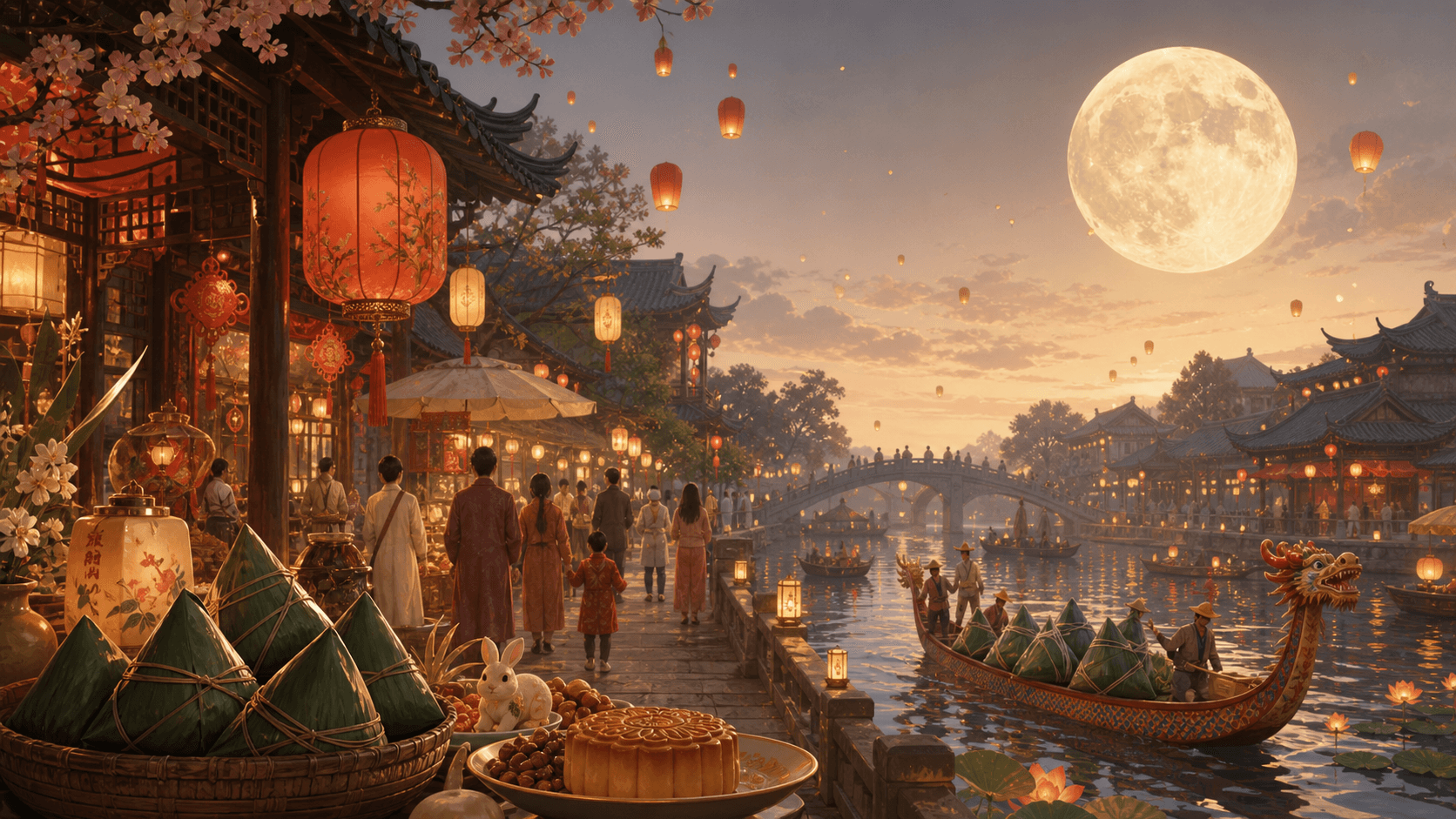
When visitors first encounter Chinese festivals, the easiest mistake is to treat them as a list of colorful customs: red envelopes at Spring Festival, mooncakes at Mid-Autumn Festival, zongzi at Dragon Boat Festival. Those details are memorable, but they are only the visible layer.
Traditional festivals grew out of a long conversation between farming seasons, lunar and solar calendars, family life, local communities, and changing ideas about how people should relate to nature and to one another. Some customs are solemn. Some are noisy and playful. Many do both at once.
Modern China adds another layer. A festival may be an old cultural observance, an official public holiday, a major travel period, a family reunion, a commercial season, or several of these at the same time. Travelers do not need to memorize every ritual. It is more useful to understand the shape of the year.
The calendar is part of the story
Many traditional festivals follow the Chinese lunar calendar, while some seasonal observances are connected to the solar terms. Their Gregorian calendar dates therefore change from year to year.
This is why Mid-Autumn Festival does not fall on the same September date every year, and why Spring Festival may arrive in late January or February. Qingming Festival is different: it is linked to a solar term and usually falls in early April.
For travel planning, always check the official holiday calendar for the specific year. A festival's cultural date and the arrangement of public days off are related, but they are not exactly the same thing.
Festivals are living culture
Chinese festivals have never been frozen museum pieces. Customs vary by region, household, age group, and personal belief. One family may prepare a careful reunion dinner; another may eat out. One city may organize a lantern fair; another may hold a temple event, a market, or a riverfront performance. A younger person may celebrate Qixi with a romantic dinner while also knowing that the festival has older associations with skill, craft, and folk tradition.
The most useful attitude is curiosity without overstatement. There is rarely one single way that every Chinese person celebrates.
A map of the Chinese festival year
The following overview is a starting map. Each festival deserves its own article later, especially because regional customs and historical layers can be wonderfully complicated.
Spring Festival: returning, renewing, beginning again
Spring Festival, often called Chinese New Year, is the largest family-centered festival of the year. It is not only one evening. The wider New Year season includes preparation, cleaning, shopping, reunion meals, visits, greetings, red envelopes, decorations, and local customs that stretch across several days.
At its emotional center is the idea of return. People travel long distances to reunite with family. The meal matters, but so does the act of coming home. For travelers, this is the most important period to plan around because transportation demand can be intense and many businesses change their hours.
Lantern Festival: a bright closing note
The Lantern Festival falls on the fifteenth day of the first lunar month. It brings the New Year period toward a festive close with lantern displays, riddles, public outings, and foods such as tangyuan or yuanxiao.
Its mood is often more public than the reunion dinner of New Year's Eve. Streets, parks, and cultural sites may become part of the celebration.
Qingming Festival: springtime and remembrance
Qingming is both a solar term and a festival of remembrance. Families may visit graves, clean burial sites, and pay respect to ancestors. At the same time, the season is associated with spring outings and the renewed life of the landscape.
Visitors should approach tomb-sweeping customs respectfully. This is not a performance arranged for tourists. It is a family practice with emotional weight.
Dragon Boat Festival: summer, protection, and remembrance
Dragon Boat Festival falls on the fifth day of the fifth lunar month. Dragon boat races and zongzi, glutinous rice parcels wrapped in leaves, are its best-known symbols.
Many introductions connect the festival with the poet Qu Yuan. That story is important, but the festival has multiple historical layers, including seasonal customs associated with summer, protection, health, and warding off harm. A fuller article should leave room for all of these strands.
Qixi Festival: more than Chinese Valentine's Day
Qixi falls on the seventh day of the seventh lunar month. It is often introduced today as a romantic festival through the story of the Cowherd and the Weaver Girl.
That is an accessible starting point, but not the whole story. Older customs also involved qiqiao: asking for skill, especially in needlework and craft. Modern romance and older folk traditions now sit side by side.
Zhongyuan Festival: remembrance and the unseen world
Zhongyuan Festival falls in the seventh lunar month and is connected with remembrance, folk ritual, and attitudes toward life and death. It is sometimes casually translated as Ghost Festival, but that label can make it sound more theatrical than it is.
The customs are varied and often local. For an outsider, a respectful explanation is more useful than treating the subject as exotic.
Mid-Autumn Festival: reunion under the full moon
Mid-Autumn Festival falls on the fifteenth day of the eighth lunar month. The full moon is associated with reunion, distance, and longing for home. Families may share mooncakes, enjoy seasonal foods, and spend time together.
For visitors, mooncake displays appear everywhere before the holiday. The packaging may look elaborate, but the emotional idea is simple: sharing a round cake under a round moon evokes completeness and togetherness.
Chongyang Festival: climbing, autumn, and respect for elders
Chongyang, or Double Ninth Festival, falls on the ninth day of the ninth lunar month. Traditional customs include climbing to high places, appreciating chrysanthemums, and enjoying the late-autumn landscape.
In modern public life, the festival is also associated with care and respect for older people. It is a good example of how an old festival can gather new social emphasis over time.
Laba, Xiaonian, and the year-end runway
Laba Festival, on the eighth day of the twelfth lunar month, is known for laba porridge in many regions. It signals that the year-end season is approaching. Xiaonian, sometimes translated as Little New Year, follows according to regional custom. Cleaning, preparing food, shopping, and household rituals build momentum toward New Year's Eve.
This gradual approach matters. Spring Festival is not a single switch flipped at midnight. It is a runway of preparation and anticipation.
Chuxi: New Year's Eve
Chuxi is the final evening of the lunar year. The reunion dinner is one of the most recognizable family meals in Chinese culture. Foods vary by region, but the meaning of gathering is widely understood.
Some households watch television, some talk late into the night, and some keep local customs. Like many traditions, the festival is both inherited and constantly adapted.
Four festivals travelers should recognize first
If you are planning a trip and only have time to remember four names, start with:
- Spring Festival: the biggest travel and family-reunion season.
- Qingming Festival: a public holiday associated with remembrance and spring outings.
- Dragon Boat Festival: known for zongzi and dragon boat races.
- Mid-Autumn Festival: a reunion festival centered on the full moon and mooncakes.
These are especially useful because they can affect ticket demand, attraction crowds, opening hours, restaurant bookings, and the rhythm of city life.
What changes for travelers
Transportation
During major holidays, train tickets, flights, and popular routes may sell out early. Spring Festival is the strongest example, but National Day and other public-holiday periods also create heavy demand. Confirm official holiday arrangements and book ahead.
Attractions
Museums, parks, historic sites, and scenic areas may use reservations, timed entry, or visitor limits. A festival can make a place more interesting and much busier at the same time.
Restaurants and shops
Opening hours vary. In large cities, many businesses continue operating, but small family-run businesses may close or shorten hours during reunion periods. Popular restaurants may require advance booking.
Local events
Lantern fairs, temple fairs, dragon boat races, markets, performances, and museum programs can be excellent ways to experience festival culture. Look for announcements from city tourism departments, museums, and the venues themselves.
Etiquette
Festival participation does not require pretending to be an expert. Ask politely before photographing ceremonies, family practices, or worship-related activities. A little attentiveness travels well.
What food tells you
Festival foods are often more than snacks. Their shapes, names, seasonal ingredients, and family associations carry meaning.
- Dumplings may appear at New Year in northern households.
- Tangyuan or yuanxiao evoke roundness and reunion at Lantern Festival.
- Zongzi are associated with Dragon Boat Festival.
- Mooncakes evoke the full moon and reunion at Mid-Autumn Festival.
- Laba porridge marks the approach of the year-end season.
Regional variation is part of the pleasure. Ask what a food means locally instead of searching for one universal answer.
A good reading path from here
This article is the overview, not the final word. The next layer should be a series of focused guides:
- Spring Festival: the full New Year timeline and travel planning
- Lantern Festival: lantern fairs, riddles, and tangyuan
- Qingming Festival: remembrance, spring outings, and etiquette
- Dragon Boat Festival: zongzi, races, Qu Yuan, and seasonal customs
- Qixi Festival: romance, craft, and the Weaver Girl story
- Zhongyuan Festival: respectful cultural context
- Mid-Autumn Festival: the moon, mooncakes, and reunion
- Chongyang Festival: autumn customs and respect for elders
- Laba and Xiaonian: how China prepares for New Year
Final summary
Chinese festivals are best understood as a rhythm of relationships: between family members, between the living and their ancestors, between communities and the seasons, and between old customs and modern life.
For travelers, the practical lesson is simple: check the calendar, book early during major holidays, and leave room for local variation. The cultural lesson is even better. A festival is not just something to watch. It is a moment when a society reveals what it chooses to remember, share, and renew.
Sources and reference checks
- 余世存:《节日之书》
- 萧放:《传统节日:一宗重大的民族文化遗产》
- 张勃:《中国传统节日的文化内涵》
Conversation
Questions and comments
Share a question, correction, or reading note. Most comments appear automatically. Some are held briefly for review.
Need a private reply? Email chiyaoyaoya@gmail.com.
Loading comments...