Learn Chinese
Mandarin for Airports, Taxis, Metros, and Trains in China
One practical Mandarin guide for airports, taxis, buses, metro stations, train stations, and high-speed rail.
- Last updated
- 2026-06-02
- Best for
- Travelers moving between airports, cities, and neighborhoods
- May change
- Routes, ticket procedures, station signage, and transport rules
First, know the difference
These transport systems solve different travel problems:
- 地铁 — dì tiě — Metro or subway. Use it for travel within a city.
- 公交车 — gōng jiāo chē — Public bus. Use it for local routes within a city.
- 火车 — huǒ chē — Train. Use it for travel between cities or regions.
- 高铁 — gāo tiě — High-speed rail. It is a type of train service, usually faster and commonly used between cities.
A metro station and a railway station are not the same place. 火车站 — huǒ chē zhàn — means railway station. 高铁站 — gāo tiě zhàn — means high-speed rail station. A city may have several railway stations, so always show the exact Chinese station name on your ticket.
At the airport
- 机场 — jī chǎng — Airport.
- 到达 — dào dá — Arrivals.
- 出发 — chū fā — Departures.
- 行李 — xíng li — Luggage.
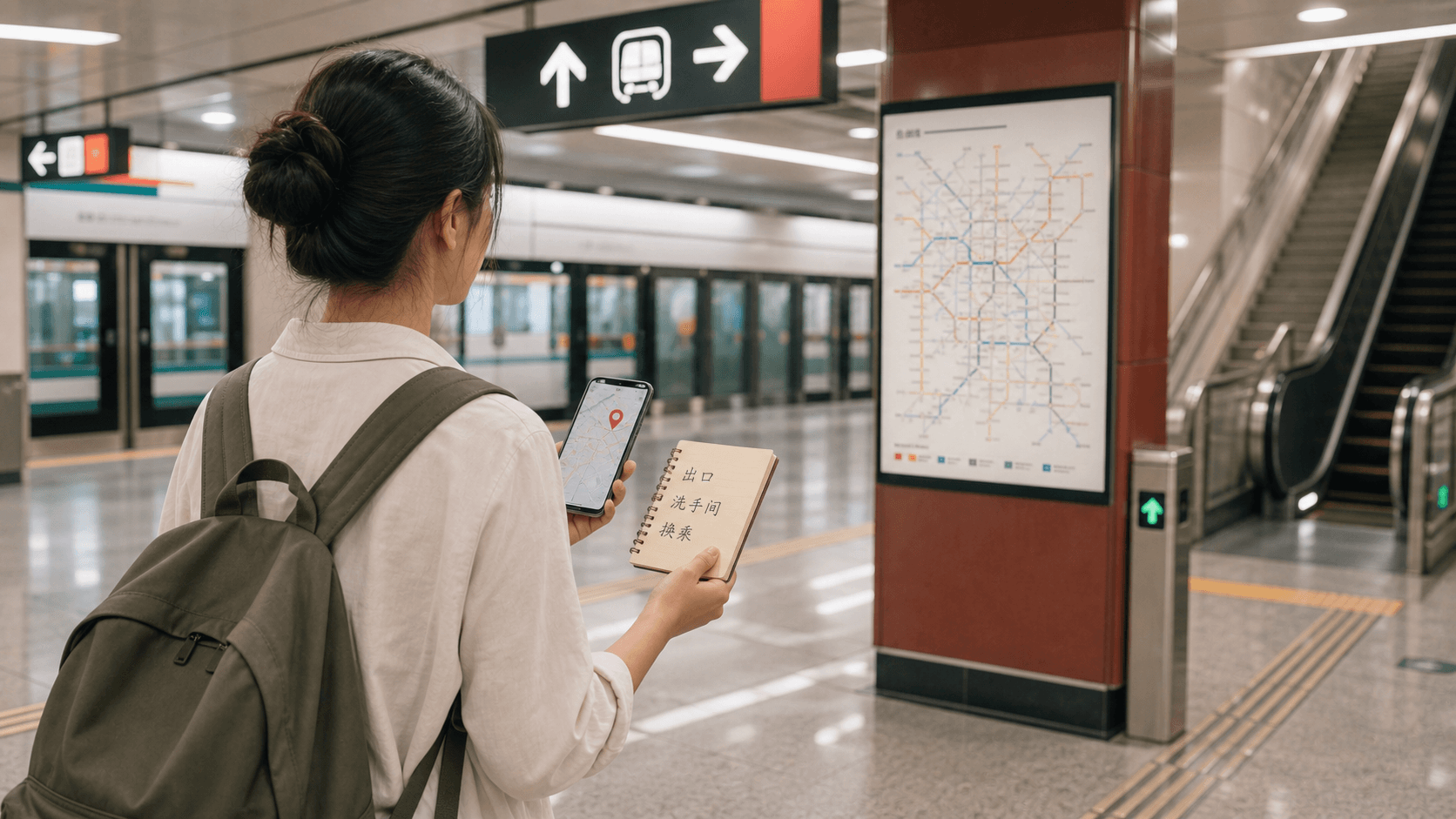
- 出口 — chū kǒu — Exit.
- 洗手间 — xǐ shǒu jiān — Restroom.
- 请问,出口在哪里?— qǐng wèn, chū kǒu zài nǎ lǐ? — Excuse me, where is the exit?
- 我的行李在哪里?— wǒ de xíng li zài nǎ lǐ? — Where is my luggage?
Taxi and ride-hailing
Keep your destination open on your phone. A Chinese address is more reliable than trying to pronounce a street name.
- 我想去这个地方。— wǒ xiǎng qù zhè ge dì fāng. — I want to go to this place.
- 请在这里停车。— qǐng zài zhè lǐ tíng chē. — Please stop here.
- 大概需要多久?— dà gài xū yào duō jiǔ? — About how long will it take?
- 我听不懂,请发短信。— wǒ tīng bù dǒng, qǐng fā duǎn xìn. — I do not understand. Please send a text message.
Buses and metros
- 地铁站在哪里?— dì tiě zhàn zài nǎ lǐ? — Where is the metro station?
- 公交车站在哪里?— gōng jiāo chē zhàn zài nǎ lǐ? — Where is the bus stop?
- 这是几号线?— zhè shì jǐ hào xiàn? — Which metro line is this?
- 我要去这个站。— wǒ yào qù zhè ge zhàn. — I want to go to this station.
- 在哪一站下车?— zài nǎ yí zhàn xià chē? — At which stop should I get off?
- 左边 / 右边 — zuǒ biān / yòu biān — Left / right.
- 一直走 — yì zhí zǒu — Go straight.
Trains and high-speed rail
- 我有票。— wǒ yǒu piào. — I have a ticket.
- 我想买票。— wǒ xiǎng mǎi piào. — I want to buy a ticket.
- 这是哪个火车站?— zhè shì nǎ ge huǒ chē zhàn? — Which railway station is this?
- 检票口在哪里?— jiǎn piào kǒu zài nǎ lǐ? — Where is the ticket gate?
- 几点出发?— jǐ diǎn chū fā? — What time does it depart?
- 几点到?— jǐ diǎn dào? — What time does it arrive?
- 我的座位在哪里?— wǒ de zuò wèi zài nǎ lǐ? — Where is my seat?
Keep your passport and current ticket screen ready. The station name, train number, date, and departure time on your booking are more precise than a long spoken explanation.
Sources and reference checks
- Beginner Mandarin learning references
- Travel Chinese phrase references
Conversation
Questions and comments
Share a question, correction, or reading note. Most comments appear automatically. Some are held briefly for review.
Need a private reply? Email chiyaoyaoya@gmail.com.
Loading comments...