C-Drama Culture Guide
Chinese Harem Drama Titles and Palace Hierarchy Explained
A fuller guide to Chinese harem drama titles, palace hierarchy, consort ranks, etiquette, visual status, and Western noble-title comparisons.
- Last updated
- 2026-05-31
- Best for
- Costume drama viewers who want to understand harem titles, court rank, and palace power
- May change
- Drama setting, dynasty-specific usage, subtitle translations, and fictional worldbuilding
In a harem drama, a title is not just a polite label. It is a location on the power map: who may speak, who must bow, who receives gifts, who is watched, and who is suddenly in danger.
A quick definition
Chinese harem drama titles are formal names of rank, relationship, and address used inside stories about emperors, empresses, consorts, princes, princesses, officials, servants, and palace women. They tell the audience who has status, who has access to power, who belongs to the imperial family, and who must be very careful before opening their mouth.
English subtitles often translate many of these terms as Your Majesty, Your Highness, Empress, Noble Consort, Consort, Concubine, Lady, Lord, or Prince. These translations help, but they cannot always carry the full social meaning of the Chinese terms.
For a new viewer, the most important point is simple: palace language is hierarchy made audible. Every title tells you where a character stands, who stands above them, and how dangerous the room has become.
Where palace titles come from
Chinese court titles grew from long histories of monarchy, bureaucracy, family hierarchy, ritual order, and formal etiquette. The imperial court was not only a royal family. It was also a political institution. Language helped organize rank, authority, gender roles, kinship, service, and ritual behavior.
Different dynasties used different systems. A Song-inspired drama may not use the same address system as a Qing-inspired drama. Fictional palace dramas may borrow from several periods or simplify titles so viewers can follow the plot. This is why title charts can help, but they should not be treated as universal law.
Still, the larger logic is stable: in a court setting, language shows order. To call someone by the wrong title is not a small grammar mistake. It can suggest ignorance, disrespect, rebellion, intimacy, insult, or political positioning. In palace drama terms, one wrong word can do the work of a dagger, only with better sleeves.
The harem is not only romance
The word "harem" can make overseas viewers imagine only jealousy or romance, but Chinese harem dramas are usually doing more than that. They use the emperor's inner palace to dramatize hierarchy, survival, family interest, motherhood, inheritance, ritual, and competition for limited security.
The women in these stories are often positioned through rank. Their lives may be shaped by favor, childbirth, family background, residence, clothing, servants, gifts, ceremonial treatment, and access to the emperor or empress. A title can improve daily life, but it can also increase danger. The higher someone rises, the more visible she becomes.
That is one of the core tensions of the genre: promotion looks like success, but success attracts attention. In a harem drama, being ignored can be painful; being noticed can be lethal.
A Western comparison: titles as readable power
For Western viewers, a useful comparison is the European noble title system. In Britain, for example, peerage ranks such as duke, marquess, earl, viscount, and baron are not the same as Chinese palace titles, but they work in a similar reading system. If a character is introduced as a duke rather than an earl, the audience immediately understands that rank matters.
The title carries history, inheritance, social position, and expectations about how others should behave. It tells people where to place the character before the character has done anything in the scene.
Chinese palace titles work in a comparable way inside drama. Huanghou is not simply "the emperor's wife." It signals the central female rank of the inner palace. Huangguifei, guifei, fei, pin, guiren, changzai, and daying are not decorative names. They form a ladder of status, access, ritual respect, and vulnerability.
The shared logic is hierarchy. The cultural expression is different. A European title such as duke often points toward aristocratic rank, land, inheritance, and noble lineage. A Qing-style harem title such as fei or pin places a woman inside the emperor's household, where favor, ritual, childbirth, residence, and factional danger may all matter.
The basic ranking logic
Harem dramas often present the inner palace as a pyramid. At the top is the empress, who holds the highest formal female position. Below her may be high-ranking consorts, noble consorts, ordinary consorts, concubines, noble ladies, attendants, and other lower-ranking women depending on the dynasty or fictional setting.
Qing-inspired dramas often use a sequence that viewers may recognize: huanghou, huangguifei, guifei, fei, pin, guiren, changzai, and daying. A drama may simplify or adjust the list, but the dramatic idea remains clear: rank affects resources, visibility, and risk.
Rank can decide who receives better rooms, more servants, richer clothing, more formal respect, and greater access to ritual occasions. It can also affect how others speak to the character, whether servants can neglect her, and whether powerful people consider her useful.
That is why a promotion scene is rarely just happy. A new title may mean better treatment, but it also means sharper competition. Palace status is not a comfortable sofa. It is a chair placed very close to the fire.
Titles, address, and emotional distance
Palace titles also control emotional distance. A character may call someone by a formal title in public and a softer term in private. A prince may address the emperor as ruler in one scene and father in another. A consort may call another woman sister as etiquette, but the word may hide rivalry, fear, mockery, or strategic politeness.
This is why subtitles struggle. English may use "Your Highness" or "my lady" for several different Chinese forms. The subtitle can tell you the basic rank, but it may lose the emotional temperature.
Watch for changes. If a character suddenly becomes more formal, they may be creating distance. If they use a warmer address, they may be asking for intimacy or protection. If they use a title too loudly in public, they may be reminding everyone of the hierarchy. Palace drama characters do not only speak. They position.
Rank is also shown through objects, clothing, and space
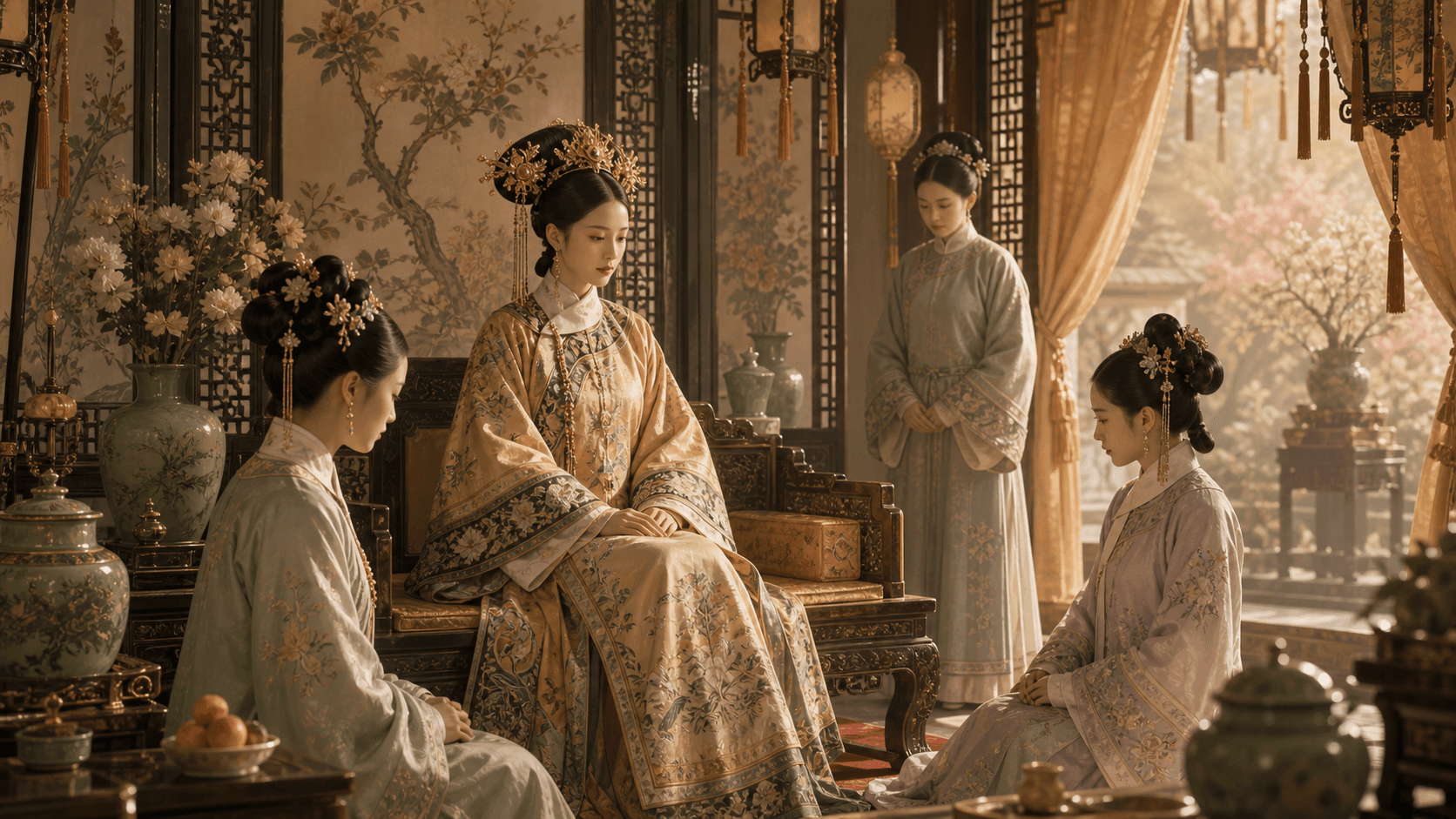
Titles are the spoken part of hierarchy, but palace dramas also show rank visually. Palace Museum materials on Qing court dress and consort life show how status could appear through regulated clothing, colors, accessories, ritual items, residence, and daily treatment.
That means a character's title may be reinforced by what she wears, where she lives, who serves her, what gifts she receives, where she sits, and how others greet her. A robe, hair ornament, room, sedan chair, cup, meal, or seating order can become part of the power system.
For foreign viewers, this is similar to how Western period dramas use crowns, coronets, uniforms, coats of arms, seating order, forms of address, and table placement to show rank without pausing for a lecture. The visual world is already telling you who matters.
Why childbirth and family background matter
In many harem dramas, a woman's rank is not only personal. It can affect her family outside the palace, and her family background can affect her position inside it. A consort from a powerful clan may bring political value. A woman who gives birth to a prince may become more important because motherhood is tied to succession and imperial continuity.
This is why palace women are often watched through several lenses at once. Is she favored? Is her family useful? Has she produced an heir? Does she threaten another faction? Is she close to the empress? Does she have servants loyal to her? A title may answer one question, but the drama is usually asking all of them.
Western royal and noble dramas often use a similar structural logic. A queen, duchess, or noble bride may be evaluated not only as an individual, but through lineage, fertility, inheritance, alliance, and proximity to the crown. The terms are different, but the social pressure is recognizable.
Why servants and lower titles matter too
New viewers often focus on empresses and consorts, but palace dramas also depend on servants, attendants, eunuchs, maids, and lower-ranking women. Their titles and forms of address show distance from power, but they may still control information, access, and daily survival.
A trusted maid can carry secrets. A senior servant can enforce etiquette. A palace eunuch may know who visited whom, which gift arrived, or which order came from which household. In a tightly controlled world, information becomes power, and lower-ranked characters may become essential players.
This is another reason palace dramas feel dense. The title ladder is not only vertical. It is also a network of access.
Example: Empresses in the Palace
Empresses in the Palace is useful for understanding how harem rank, address, etiquette, and survival fit together. Characters are not only competing for affection. They are positioned within a formal system where titles affect housing, servants, ritual respect, punishment, visibility, and political usefulness.
For a new viewer, the exact ladder may feel overwhelming. But the basic reading is clear: when a woman's rank changes, her social reality changes. People speak to her differently. They treat her differently. Her danger changes too.
This is where the Western comparison helps. In a European noble drama, moving closer to the crown can change invitations, marriage prospects, inheritance expectations, and political risk. In a Chinese harem drama, promotion inside the imperial household works through a different system, but the audience response is similar: everyone understands that the room has shifted.
Example: Story of Yanxi Palace
Story of Yanxi Palace is another useful example because it makes hierarchy visible through work, residence, costume, etiquette, and promotion. The heroine begins far from the top of the palace structure, so viewers can watch how palace rules are learned from below.
This kind of story helps beginners because it turns the palace into a school of rank. The audience learns who can command, who must obey, who can punish, and who can quietly manipulate the rules. The title system becomes clearer because the heroine has to survive it step by step.
Example: Serenade of Peaceful Joy
Serenade of Peaceful Joy is useful because it draws attention to Song dynasty court language and forms of address. It reminds viewers that palace titles are not one universal system. Different historical settings can use different words, etiquette, and political assumptions.
This is why serious viewers should be careful with simple title charts. A chart may help, but context matters. The same English translation can hide different Chinese forms.
How to watch palace titles
When titles start flying across the screen, ask:
- Is this person royal, official, noble, serving, or outside the court?
- Is the title showing family relationship, political rank, harem rank, or service role?
- Did the character choose a warmer, colder, higher, or lower form of address than expected?
- Did someone gain a title, lose a title, or receive a different public treatment?
- Does the visual world show the same rank through clothing, space, servants, or gifts?
- Did the subtitle simplify several different Chinese terms into one English word?
You do not need to understand every title in the first episode. Palace dramas usually teach hierarchy through repetition, reaction, and consequence.
A final way to understand harem titles
Chinese harem drama titles are not just old-fashioned words. They are a system for showing power, distance, legitimacy, danger, family interest, and emotional control.
The Western noble-title comparison helps because both systems make rank readable. But Chinese harem drama adds a specific inner-palace pressure: favor, motherhood, ritual, residence, servants, and imperial household politics all meet in one enclosed world.
Once you begin noticing titles, harem dramas become much easier to read. A single word can tell you who is protected, who is trapped, who has just risen, who has just been marked, and who should probably stop talking before the tea gets cold.
Sources and reference checks
- 朱小平:《清代宫廷称谓与礼仪》
- 刘芹:《看〈清平乐〉,学宋朝宫廷称谓》
- 孙军凯:《略论“官家”称谓与宋代皇权观念世俗化》
- 宋超:《中国后宫题材电视剧研究》
- 杨宁宁:《重述历史语境下的〈史记〉后宫史事与电视宫斗剧》
- 故宫博物院:“清代妃嫔生活展”
- 故宫博物院:清代宫廷服饰制度及其文化内涵
- UK Parliament: Peerages and membership of the House of Lords
Conversation
Questions and comments
Share a question, correction, or reading note. Most comments appear automatically. Some are held briefly for review.
Need a private reply? Email chiyaoyaoya@gmail.com.
Loading comments...