Chinese Culture
Chinese Zodiac Explained
An overview of the Chinese zodiac: its twelve animals, historical development, everyday uses, and the cultural meaning behind the cycle.
- Last updated
- 2026-05-31
The Chinese zodiac is easy to recognize and easy to oversimplify. It is a twelve-animal cycle, but it is also a living piece of calendar culture, family conversation, public art, museum display, and everyday humor.
The twelve animals
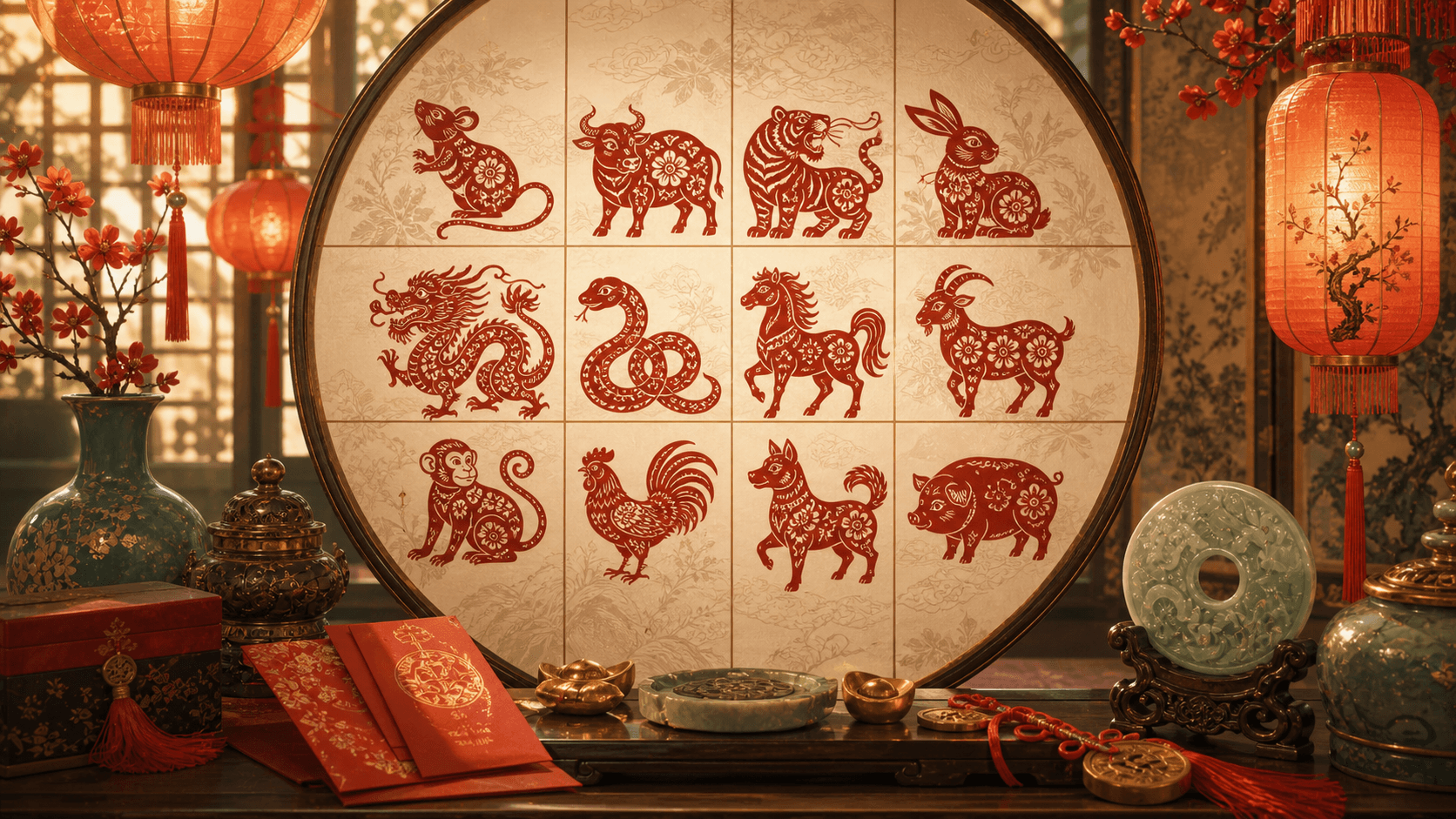
The Chinese zodiac, often called shengxiao or shuxiang in Chinese, is a repeating cycle of twelve animals:
1. Rat
2. Ox
3. Tiger
4. Rabbit
5. Dragon
6. Snake
7. Horse
8. Goat
9. Monkey
10. Rooster
11. Dog
12. Pig
Each lunar year is associated with one animal. After the Year of the Pig, the cycle returns to the Rat.
That basic sequence is the first thing to learn. The second is just as important: the Chinese zodiac is not the same system as the twelve signs commonly used in Western astrology.
One practical detail matters when you look up your own sign: the zodiac year changes at Lunar New Year, not automatically on January 1. People born in January or early February should check the lunar calendar date for their birth year instead of relying on the Gregorian year alone.
Not a Chinese version of star signs
Western zodiac signs are usually explained through a person's birth date within the year. The Chinese zodiac most commonly identifies a birth year within a repeating twelve-year cycle.
If someone asks, "What is your shuxiang?" they are usually asking for your zodiac animal. In casual conversation, the answer can also provide a rough clue about age because the animal repeats every twelve years. Context matters, of course. A person may be 24, 36, 48, or another age within the same cycle.
The Chinese zodiac also belongs to a larger traditional system of timekeeping. The twelve animals became widely paired with the Twelve Earthly Branches. For a beginner, it is enough to know that the animals are not a random personality quiz. They sit inside a much older cyclical way of organizing time.
A compact language for time and space
In *The Chinese Zodiac*, Wu Yucheng offers a more useful starting point than the familiar horoscope comparison. He describes the zodiac as a set of temporal and spatial ordering symbols shaped by China's long agrarian civilization.
That sounds abstract, but the underlying idea is simple. Before the twelve animals became cheerful New Year mascots, they helped make recurring time easier to name and remember. In traditional usage, zodiac animals could be associated not only with years, but also with days, months, and the twelve two-hour periods of the day. Through their pairing with the Earthly Branches, they could also help mark direction and position.
This is why the cycle feels larger than a collection of personality labels. It belongs to a worldview in which the calendar, the seasons, agriculture, astronomy, and ordinary life were closely connected.
Half of the zodiac animals are the six familiar domestic animals of traditional farming life: horse, ox, goat, pig, dog, and rooster. The full list also includes animals encountered through observation, imagination, and storytelling. The dragon stands among them as the only clearly mythical creature.
Where did the zodiac come from?
There is no single tidy origin story that explains every step of the zodiac's development. That is part of what makes it interesting.
Scholars study early written evidence, including bamboo-slip texts from Qin-period tombs, as well as later material culture such as tomb figurines, ceramics, paintings, folk art, and decorative objects. Wu discusses Qin bamboo slips excavated at Shuihudi in Hubei and Fangmatan in Gansu. These finds matter because they show that zodiac animals were already being used in popular calendrical texts more than two thousand years ago.
The early lists were not identical in every detail to the sequence familiar today. Cultural systems take shape over time. That historical unevenness is more interesting than a neat invention story: it shows how a flexible set of associations gradually became a stable and widely recognized cycle.
The zodiac also reflects a wider human habit: using animals to think about time, character, memory, and the surrounding world. Animal-calendar traditions appear in more than one culture, and neighboring regions developed related versions with local variation.
This is not a story of a symbol created once and then left untouched. It is a long history of adaptation.
Why these animals?
Beginners often ask why the cycle contains a dragon but no cat, or why an ordinary rat appears first. Folktales offer memorable answers, especially the story of a race arranged by the Jade Emperor. In the best-known version, the animals compete to determine their order, and the Rat cleverly reaches the finish before the Ox.
The race story is enjoyable and useful for remembering the sequence. It should not be mistaken for a complete historical explanation.
The animal set brings together familiar domestic animals, wild animals, and the dragon, a powerful cultural symbol. Some animals are admired for strength, diligence, loyalty, intelligence, or agility. Others carry more mixed associations. Meanings also shift with context.
Wu's discussion of the Rat is a good example. People have long wondered why such a small animal stands first in the cycle. Folk stories offer several answers: the Rat wins a race through cleverness, surprises onlookers by riding on the Ox, or earns its position through a useful deed. These tales do not prove the historical origin of the sequence. They reveal something else: people enjoy turning an inherited order into a story that feels memorable and meaningful.
The dragon needs its own explanation
For many Western readers, the dragon is the most surprising animal in the cycle. In European stories, dragons are often threatening creatures to be defeated. In Chinese culture, the dragon has a very different history of meanings. It is associated with power, vitality, transformation, water, rain, and auspicious energy.
That does not mean every Chinese dragon image means exactly the same thing. Symbols change across dynasties, regions, objects, and occasions. But it does mean that translating long as simply "dragon" can hide a cultural difference worth noticing.
Future animal-by-animal guides should give each sign the same care, without flattening it into a stereotype.
How people use the zodiac today
The zodiac is not confined to old books. It appears in many ordinary and public settings.
New Year culture
Before a new lunar year, the incoming animal appears on decorations, greeting cards, packaging, stamps, advertisements, museum programs, and public installations. The zodiac offers a visual language that is immediately recognizable across generations.
Family conversation
Relatives may mention a child's animal sign, compare family members' signs, or use zodiac years to recall when someone was born. These conversations can be affectionate, teasing, serious, or casual.
Design and collecting
Zodiac themes appear in paper cutting, ceramics, jewelry, coins, toys, fashion, and contemporary illustration. Museums and cultural institutions use the cycle to connect natural history, folk tradition, and visual culture.
This modern life is not a break from the past so much as another adaptation. Wu traces how a system shaped in an agrarian world continues to move comfortably through stamp design, calendars, coins, greeting cards, museum exhibitions, commercial packaging, and public art. The medium changes. The pleasure of giving each year a recognizable animal face remains.
Popular entertainment
Television, online content, and social media may use zodiac personality descriptions because they are quick, familiar, and fun to share. Treat these as popular culture, not as a scientific method for understanding a person.
Zodiac years and benmingnian
A person's benmingnian is a year in which the zodiac animal of the current year matches the animal of their birth year. Because the cycle repeats every twelve years, this happens regularly throughout life.
In folk custom, benmingnian is sometimes treated as a year that deserves extra attention. Red clothing, accessories, or small objects may appear in related customs because red is widely associated with good fortune and protection.
Practices vary. Some people take them seriously, some participate playfully, and some do not think about them at all. A good cultural guide should explain the custom without assuming that every person believes the same thing.
Compatibility and personality: useful boundaries
Search online and you will quickly find claims about which animals are compatible in love, work, or friendship. You will also find personality lists: the Ox is steady, the Tiger is bold, the Rabbit is gentle, and so on.
These descriptions can be an enjoyable entry point into popular culture. They are not a reliable way to judge a real person. Chinese society is not a room full of people making major decisions from a twelve-animal chart.
Historically, birth information could matter in some marriage customs and forms of fortune telling, but the zodiac animal alone is only one small and simplified element. It should not be used to explain an entire culture, much less an individual's character.
Wu's book is unusually helpful here because it does not romanticize every custom. Its later chapters distinguish living folk culture from claims that deserve skepticism. Zodiac-based fortune telling is not reliable evidence. Nor should zodiac signs be used to justify prejudice, including old stereotypes surrounding the birth years of girls or women.
The cycle is culturally valuable without needing to become a rule for judging people.
A cross-cultural way to think about it
The easiest comparison is not "Chinese zodiac equals Western horoscope." A better comparison is this: many societies use recurring symbols to turn abstract time into something memorable and shareable.
The Chinese zodiac does this especially well. A year becomes an animal. The animal becomes a design language. The design becomes a New Year decoration, a family joke, a museum exhibition, a gift, or a conversation starter.
Related zodiac traditions across East and Southeast Asia may use different animals or tell different stories. Those variations are worth exploring rather than treating the Chinese version as the only possible form.
What travelers may notice
If you visit China around Spring Festival, the year's zodiac animal will likely be one of the first cultural motifs you see. Look for it in:
- lantern displays and public decorations
- museum exhibitions
- souvenir designs
- shopping-center installations
- stamps, coins, and seasonal gifts
- children's crafts and paper cuts
Instead of asking only, "What animal is this year?" ask a second question: "How is this animal being represented?" A cute cartoon, a traditional paper cut, a bronze-inspired sculpture, and a luxury jewelry design all tell slightly different stories about how tradition is used in modern life.
A future article for every animal
This overview is the beginning of a larger series. Each zodiac animal deserves a focused guide covering:
- its position in the twelve-animal cycle
- common stories and idioms
- historical images and material culture
- positive and negative associations
- how the animal appears in modern design
- careful notes on popular personality descriptions
- differences between cultural symbolism and literal animal behavior
The dragon should also receive a deeper cross-cultural article because its translation can be misleading when readers bring expectations from European fantasy.
Final summary
The Chinese zodiac is not simply a horoscope with twelve mascots. It is a durable cultural cycle rooted in traditional timekeeping and carried forward through festivals, family memory, storytelling, museums, and design.
Learn the twelve animals first. Then resist the urge to reduce them to personality labels. The more interesting question is how a familiar cycle has remained flexible enough to feel old, playful, personal, and contemporary at the same time.
Sources and reference checks
- 吴裕成:《中国人的十二生肖》
- 何双及:《十二生肖探源》
- 施波文:《生肖文化的展示实践与思考:以浙江自然博物院十二生肖系列展为例》
Conversation
Questions and comments
Share a question, correction, or reading note. Most comments appear automatically. Some are held briefly for review.
Need a private reply? Email chiyaoyaoya@gmail.com.
Loading comments...