Chinese Culture
Filial Piety Explained for Beginners
A balanced introduction to filial piety in Chinese culture: its history, family meanings, modern changes, and the questions it still raises.
- Last updated
- 2026-05-31
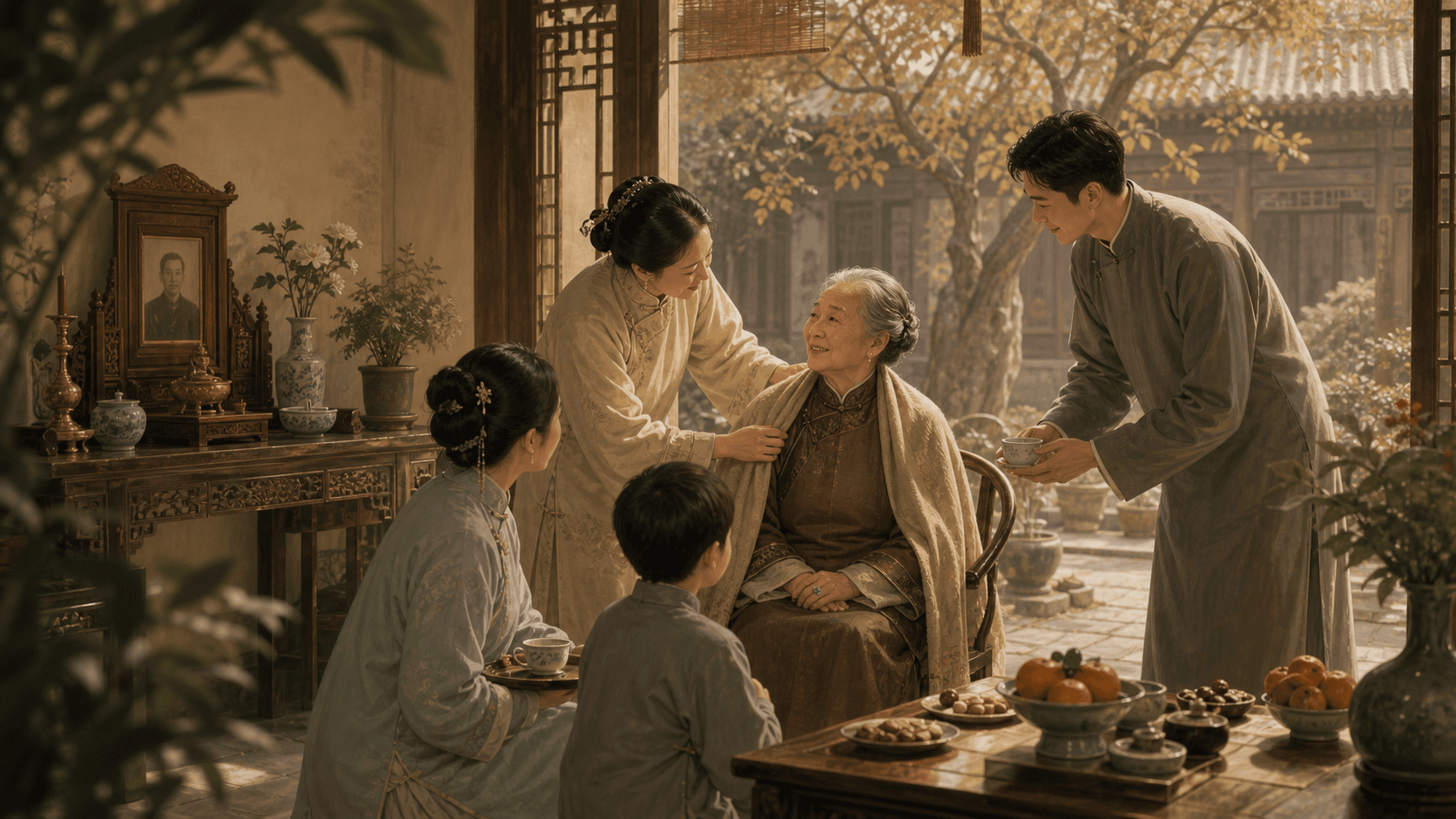
Filial piety is often introduced as respect for parents. That is true, but incomplete. Across Chinese history, xiao has included care, remembrance, family continuity, moral education, social expectation, and difficult debates about where duty should end.
Start with a better translation
The Chinese word xiao is usually translated as filial piety. The translation sounds formal, even dusty. For modern readers, it may suggest one simple rule: children must obey their parents.
That is too narrow.
Xiao has a long historical life. It has changed across different eras and has been interpreted in different ways. At its most humane, it asks how people should care for parents, respect older generations, remember those who came before them, and carry family responsibilities forward. At its most rigid, it can be used to demand obedience or suppress individual choice.
A balanced introduction needs to keep both sides in view.
Earlier roots: family continuity and remembrance
Academic discussions of xiao trace its early meanings to ancestor rites and the continuation of family life across generations. Respect for parents did not end at the boundary between life and death. Remembering ancestors, maintaining rituals, and carrying forward the unfinished concerns of earlier generations were part of the moral picture.
This helps explain why xiao cannot be reduced to good manners toward elderly relatives. It is connected to a larger sense of continuity: a person belongs to a family story that began before them and will continue after them.
Over time, the concept became increasingly centered on human relationships within the family: caring for parents, treating elders with respect, and taking family responsibilities seriously.
Confucian development
Confucian thought gave filial piety an especially important place in moral education. The family was understood as one of the first places where people learn responsibility, gratitude, respect, and care.
This does not mean that every Confucian text says exactly the same thing or that every household practiced the ideal in the same way. But the broad influence is clear: the relationship between parents and children became a foundational image for thinking about ethical life.
The classic ideal is not merely material support. Providing food and shelter matters, but care without respect can feel empty. Tone, attention, patience, and the willingness to remain present also matter.
That distinction still feels modern.
From family ethics to political morality
Filial piety did not stay inside the home. Across history, it was also connected to wider ideas about social and political order. The logic was that a person who learned respect and responsibility in the family might carry those habits into society.
This expansion created both influence and risk.
On one hand, xiao encouraged a language of care, duty, and continuity. On the other, later interpretations could turn family morality into a tool of rigid hierarchy. Extreme stories of self-sacrifice sometimes elevated obedience in ways that modern readers may find troubling.
The history of filial piety is therefore not a straight line from tradition to virtue. It includes debate, adaptation, criticism, and reconstruction.
Why the Tang dynasty is an important middle chapter
It is tempting to jump directly from early Confucian thought to modern family life. Ji Qingyang's study of filial culture in the Tang dynasty fills in an important middle layer.
By the Tang period, filial piety was not only a private family ideal. It had become part of education, governance, law, moral recognition, and public culture. The *Classic of Filial Piety* was widely studied. Tang rulers promoted filial teaching, and Emperor Xuanzong personally wrote a commentary on the text. Filial conduct could be praised publicly, while unfilial behavior could also have legal consequences.
That history is not entirely abstract. A stone monument associated with Xuanzong's commentary, commonly known as the *Stone Platform Classic of Filial Piety*, is preserved at the Xi'an Beilin Museum. It gives visitors a tangible reminder that ideas about family ethics were also carried through education, calligraphy, monuments, and public institutions.
Ji's study also shows that xiao reached beyond official doctrine. It intersected with household property, agriculture, religious life, literature, history, art, seasonal customs, and ordinary family behavior. That breadth helps explain why filial piety remained culturally durable. It was not preserved by one book alone. It was woven into institutions and daily life.
Respect for older people was also given institutional form. Ji describes Tang measures that included public recognition, ceremonial examples, local responsibilities, selected legal protections, and forms of relief or exemption connected with elder care. These arrangements should not be romanticized as a modern welfare system. Their importance is historical: they show that care for elders was discussed not only as a private feeling but also as a public concern.
The Tang example also exposes a tension that matters throughout Chinese history. Rulers could connect loyalty to the state with duty toward parents. Officials, scholars, and ordinary households did not always emphasize the same thing. For many people, the most recognizable meaning of xiao remained the plainest one: caring well for parents.
This is a useful warning for modern readers. A value may have an intimate family core and a political history at the same time.
Filial piety is not blind obedience
This is the most important correction for beginners.
Respecting parents does not require agreeing with every parental decision. Caring for family does not mean accepting harm, manipulation, or impossible demands. Modern family life includes questions of privacy, marriage choice, career choice, caregiving, distance, money, and emotional boundaries.
Chinese families negotiate these questions in many different ways. Some parents are traditional; others are relaxed. Some adult children live nearby; others live in another province or another country. Some families talk openly; others struggle to do so.
There is no single Chinese household.
What xiao can look like today
Modern filial piety often appears in practical, ordinary forms:
- calling parents regularly
- visiting during major holidays
- helping with medical appointments
- contributing to elder care
- listening to family stories
- remembering ancestors during festivals such as Qingming
- considering parents' feelings when making major life decisions
- making sure older relatives are not socially isolated
These actions can express affection, responsibility, or both.
Technology changes the form. A child living far away may arrange deliveries, send messages in a family group chat, book transportation, transfer money, or schedule medical visits online. Distance does not erase care, but it can make care more complicated.
Holidays make the idea visible
Spring Festival is the clearest example. The scale of New Year travel is not only an economic or transportation story. It is also a family story. Returning home for a reunion dinner can carry emotional importance even for people who live independent lives during the rest of the year.
Qingming Festival makes another dimension visible: remembrance. Families may visit graves and honor ancestors. Chongyang Festival, especially in modern public discussion, highlights respect and care for older people.
Festivals do not prove that every family is harmonious. Sometimes they expose tension precisely because the expectation of reunion is so strong. That tension is part of the cultural reality too.
Family approval in romance and marriage
Foreign viewers often notice how frequently parents appear in Chinese romance dramas. A couple may love each other, yet family approval remains a major question.
This is not only a dramatic obstacle invented by screenwriters. Marriage can be understood as more than the union of two individuals. It may also affect two families, expectations around housing, caregiving, finances, children, location, and social compatibility.
The importance of family approval does not mean parents always win. Many dramas are interested in the negotiation itself: when should adult children listen, when should they resist, and how can a family adapt without breaking apart?
That is why filial piety can produce emotionally rich stories. It is not a simple command. It is a field of competing duties.
Caregiving and the aging family
The most serious modern conversations about xiao often concern elder care.
Longer life expectancy, smaller households, work pressure, migration, and the cost of care can make old expectations difficult to fulfill. Adult children may genuinely want to care for parents while also managing jobs, children, and geographic distance.
A useful modern interpretation of filial piety cannot rely only on moral pressure. It must also ask practical questions:
- What support do older people actually need?
- How should siblings share responsibility?
- What can families manage, and where is public or professional support necessary?
- How can older people retain dignity and independence?
- How can caregivers avoid exhaustion?
Respect becomes more meaningful when it is translated into workable care.
A cross-cultural comparison
Filial piety is culturally important in China, but the underlying questions are not uniquely Chinese.
Families everywhere negotiate obligations across generations. Adult children in Europe, North America, Latin America, Africa, and Asia all face questions about visiting, caregiving, financial support, inheritance, family memory, and the emotional weight of parental expectations.
The difference is partly one of emphasis. Chinese culture has a long, explicit vocabulary for treating intergenerational responsibility as a moral subject. That vocabulary can make family duty more visible and sometimes more demanding.
Recognizing the shared human problem helps avoid two mistakes: romanticizing Chinese families as naturally harmonious or portraying them as trapped by tradition.
What C-dramas do with filial piety
Television dramas often turn xiao into a story engine.
You may see:
- a character torn between a career opportunity and an ill parent
- a couple negotiating whether to live near one family or the other
- parents opposing a marriage because they worry about stability
- siblings disagreeing over caregiving responsibility
- a historical character protecting the reputation of a family or clan
- an older relative using sacrifice as emotional pressure
Some characters behave generously. Some behave badly while speaking the language of duty. The drama often lies in deciding which is which.
For viewers, the useful question is not "Why do Chinese characters always obey their parents?" It is "What kind of obligation does this character believe they owe, and why?"
Reconstructing the idea for modern life
Scholars discussing the modern future of filial piety often make an important distinction: inherited values can be reinterpreted.
The durable core is care, gratitude, respect, and responsibility between generations. The parts that deserve criticism are rigid hierarchy, coercion, and the demand for self-erasure.
That is not a rejection of tradition. It is how traditions remain alive. A value survives because people continue to ask what it should mean under new conditions.
Common misunderstandings
"Filial piety means parents control adult children."
Family influence can be strong, but adult children negotiate, disagree, compromise, and set boundaries.
"Modern young people no longer care about xiao."
The form is changing. Many younger people still care deeply about parents while questioning older assumptions about obedience, marriage, work, and caregiving.
"A harmonious family never argues."
Families often argue because the relationships matter. Harmony is not the absence of disagreement.
"Tradition provides an easy answer."
It does not. Filial piety is a vocabulary for discussing responsibility, not a magic solution to every family problem.
Final summary
Filial piety is best understood as an evolving tradition of intergenerational responsibility. It began with deep ideas about family continuity and remembrance, became central to moral education, expanded into broader social ideals, and sometimes hardened into demands that deserve criticism.
Its modern future is not blind obedience. It is thoughtful care: respecting parents and elders, keeping family memory alive, sharing practical responsibility, and making room for the dignity and boundaries of every generation.
Sources and reference checks
- 季庆阳:《孝文化的传承与创新:基于大唐盛世的考察》
- 焦国成:《孝的历史命运及其原始意蕴》
- 伏亮:《孝的传承与重建:以〈孝经〉为中心的考察》
- 刘海洋:《中国传统孝文化的现代解构》
Conversation
Questions and comments
Share a question, correction, or reading note. Most comments appear automatically. Some are held briefly for review.
Need a private reply? Email chiyaoyaoya@gmail.com.
Loading comments...